

Call for Consultation (337) 366-8994
Call for Consultation (337) 366-8994






Disclaimer: This page provides general information only and does not constitute legal advice. Reading this page does not create an attorney-client relationship. Laws vary by jurisdiction and change frequently. Always consult a licensed attorney for advice specific to your situation.
An 18-wheeler changed lanes or turned into you, and now you are being told it was your fault for being in the driver’s blind spot. That one sentence from an adjuster ends a lot of claims before anyone looks at the truck. It should not end your claim without a closer look.
A blind spot truck accident lawyer starts somewhere else: with what the driver was required to do before you entered the blind spot and/or moved that truck.
The Ikerd Law Firm handles Louisiana 18-wheeler wreck cases across Louisiana and Texas. You can contact our Lafayette office or call (337) 366-8994.
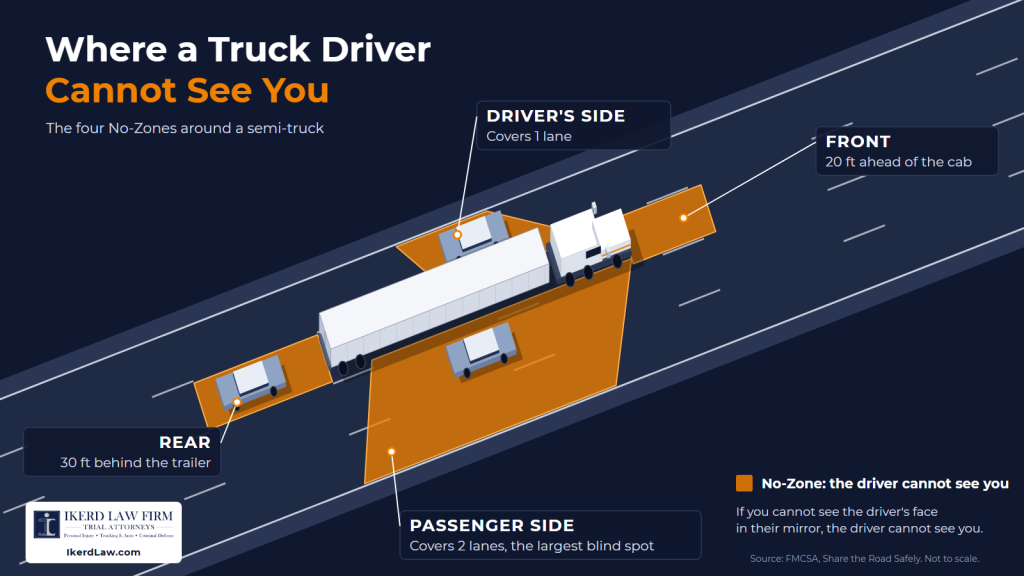
The no-zone is the space around a large truck where the driver may not be able to see you. The Federal Motor Carrier Safety Administration puts it plainly in its road safety guidance for drivers: if you cannot see the face of a truck or bus driver in your mirror, that driver cannot see you.
Those areas sit on all four sides of a tractor-trailer. Where each one falls depends on the truck, the trailer, and how the mirrors are set.
| Area Around the Truck | Why You May Disappear There | The Kind of Crash Where a Driver Could Miss You |
|---|---|---|
| Directly in front of the cab | The driver sits high and far back from the bumper. | You merge in, then slow down, and the driver has no view of you. |
| Directly behind the trailer | There is no interior mirror looking through a loaded trailer. | The truck backs up, or stops short, with you behind it. |
| Along the right side | The cab sits on the left, so the far side is the harder one to cover. | The trailer swings right, or the truck moves into the next lane. |
| Along the left side | The area beside and slightly behind the cab falls between mirror views. | The truck changes lanes while you are passing. |
Learning where truck blind spots sit is useful, and the phrase “semi truck no zone” is worth knowing for the same reason. Neither one decides who is at fault in your crash. We cover where these crashes happen in our guide to I-10 and I-49 corridor truck crashes in Louisiana.
Two other things about large trucks show up in the same crashes, and the same FMCSA guidance names both of them. Trucks and buses “need the length of up to two football fields to safely stop,” and they “need extra space and time to make wide turns carefully.”
That matters when a company blames the no-zone for a right-turn crash. FMCSA tells drivers to expect wide turns, noting that trucks and buses “may not be able to easily turn from the right lane and may initially move left to create enough turning space.” A truck that swings left before turning right is doing what FMCSA describes, and your position relative to the trailer is only part of the picture.
No driver can see every inch around a tractor-trailer, and federal rules account for that. They set what the truck must carry, and the training curriculum sets what the driver has to be taught.
None of that makes a trucking company automatically responsible for a blind spot crash. It does widen the question beyond where your vehicle was to what the driver did with the mirrors and the training the job required.
Here is the argument you are up against. The company says you put yourself somewhere its driver could not see, so the crash is on you.
An attorney who focuses on 18-Wheeler wreck cases and trains in this area of law knows how to counter this argument. The simple answer is that there should almost never be a “blind” spot. Unless the smaller vehicle is driving recklessly and excessively speeding up to the tractor-trailer, no vehicle should ever enter the “no-zone” without the truck driver’s knowledge.
CDL drivers are trained on and responsible for checking their mirrors and surroundings every three seconds. Thus, if a vehicle is in an area the mirrors cannot see during a lane change, the driver should have clocked it minutes earlier when it drove up next to the 18-wheeler. The CDL driver should never be surprised by someone being next to them.
Louisiana responds with a comparative fault system instead of an all-or-nothing rule. Under Article 2323 of the Louisiana Civil Code, a court assigns a percentage of fault to everyone who caused or contributed to the injury.
What that percentage does to a claim changed recently, and the change matters:
So partial fault is not automatically the end of a Louisiana claim. Where your share of fault falls is a factual question, and the driver’s conduct is part of that same question. That is why Louisiana comparative fault law and the driver’s own duties get argued together rather than separately.
Expect the argument to run in both directions. The company points to where your vehicle sat before the collision. Your side points to the mirrors, the training, and what the truck’s own records show about the seconds before impact.
Neither side sets your percentage. Article 2323 says the degree of fault is determined for everyone who caused or contributed to the loss, “regardless of whether the person is a party to the action or a nonparty.”
Fault in Louisiana starts with Article 2315, which states that “every act whatever of man that causes damage to another obliges him by whose fault it happened to repair it.”
The answer to who is at fault in a blind spot accident sits in records you have never seen. Several are the carrier’s own records, and federal rules say what those must contain. Others come from the truck and from the scene.
Those records are also the reason speed matters after a crash. Some are kept for a limited period, and vehicles get repaired or returned to service.
A written request to preserve them goes out early for that reason. We cover the wider set in our guide to the federal trucking rules in Louisiana truck cases.
If a carrier has already told you that you were in the blind spot, contact our Lafayette office before those records age out.
You were blamed at the scene, and that is the other driver’s account rather than a finding. These steps help you stay flexible while the facts are clarified.
You do not have to work out the percentages or hunt for the truck’s records yourself. Requesting those records and reading them against Louisiana law is the job you would be hiring an attorney for.
Chad M. Ikerd handles 18-wheeler cases across Louisiana and Texas, and he works on his clients’ cases himself. Consultations for personal injury cases are free. Call (337) 366-8994 or contact our Lafayette office.
This page explains Louisiana law. If your crash happened in Texas, different law may apply, and we handle Texas trucking cases as well.
It depends on the facts. Under Article 2323 of the Louisiana Civil Code, a court assigns a percentage of fault to everyone who caused or contributed to the injury, and under the version of that article in force since January 1, 2026, an injured person whose share reaches 51 percent “shall not be entitled to recover damages.” Below that share, damages are reduced in proportion to the percentage of negligence rather than denied. Which version governs a particular crash depends on its date, which is a question for an attorney.
It is commonly called the no-zone. The Federal Motor Carrier Safety Administration describes large trucks and buses as having “large blind spots,” and its road safety guidance for drivers states that if you cannot see the driver’s face in their mirror, that driver cannot see you.
Federal rules do not phrase it that way. Two requirements sit behind the question: 49 C.F.R. § 393.80 requires mirrors on each side, positioned to show “a view of the highway to the rear, along both sides of the vehicle,” and the training curriculum at Appendix A to Part 380 requires instruction in visual search and in the proper use of mirrors. Whether a particular driver met the standard of care in a particular crash is determined by the evidence.
 Ikerd Law Firm
 Sep 29, 2026