

Call for Consultation (337) 366-8994
Call for Consultation (337) 366-8994







Disclaimer: This content is for informational purposes only and does not constitute legal advice. Each case is unique; consult a licensed attorney for advice specific to your situation.
If you or someone in your family was recently convicted in Louisiana, you may hear two terms in the same conversation: direct appeal and post-conviction relief.
The first thing to know about post-conviction relief vs. appeal in Louisiana is that they are two separate procedures, each with its deadline, its court, and its own limits on what can be reviewed.
The Ikerd Law Firm handles direct criminal appeals for clients in South Louisiana and the Acadiana region. The firm does not handle post-conviction relief.
If a direct appeal is still available in your case, you can reach our Lafayette office or call (337) 366-8994.
A direct appeal asks a higher court to review a criminal conviction for legal error. Under La. C.Cr.P. art. 912.1, a defendant may appeal to the court of appeal from a judgment in a criminal case triable by jury.
La. C.Cr.P. art. 920 limits what the court of appeal will consider to two things. The first is an error the defense raises in the appeal. The second is an error that is visible in the court filings and proceedings without reviewing the evidence. Under La. C.Cr.P. art. 921, an error is not grounds for reversal unless it affects the substantial rights of the accused.
Under La. C.Cr.P. art. 914, the motion for appeal must be made no later than 30 days after the judgment or ruling being appealed. If a motion to reconsider the sentence was filed, the 30 days run from the ruling on that motion.
Once the order of appeal is entered, La. C.Cr.P. art. 916 transfers jurisdiction from the trial court to the court of appeal. After that point, the trial court may act only on the limited matters listed in the article, such as bail.
Under La. C.Cr.P. art. 914.1, the party appealing must request the transcript of the parts of the trial needed for the errors that will be raised at the same time the motion for appeal is made.
Because the transcript request is tied to the errors that will be raised, those errors are identified at the start of the appeal. If the defendant is not indigent, the cost of preparing the transcript must be paid to the court reporter or the appropriate agency within 20 days of the mailing of notice.
Under La. C.Cr.P. art. 915, the trial court must grant or deny a properly made motion for appeal within 72 hours, not counting legal holidays. The same article provides that once a motion for appeal has been made on time, the appeal is not affected by any fault or omission on the part of the trial court.
Our guide to the Louisiana appeal process walks through each stage, and our direct appeal guide explains what this kind of review can and cannot address.
Post-conviction relief is a different proceeding with a different purpose. La. C.Cr.P. art. 924 describes it as a collateral action, meaning a separate proceeding that challenges a person’s detention after the conviction and sentence have become final.
Under La. C.Cr.P. art. 925, the application is filed in the parish where the person was convicted. La. C.Cr.P. art. 930.3 lists the only grounds on which relief may be granted. One of them is that the conviction was obtained in violation of the United States Constitution or the Louisiana Constitution.
We explain post-conviction relief here only so that you can tell it apart from a direct appeal. The Ikerd Law Firm does not accept post-conviction relief cases. If your situation calls for a post-conviction application rather than a direct appeal, our office is not able to take on that work.
This section summarizes the main differences and explains them in the sections that follow.
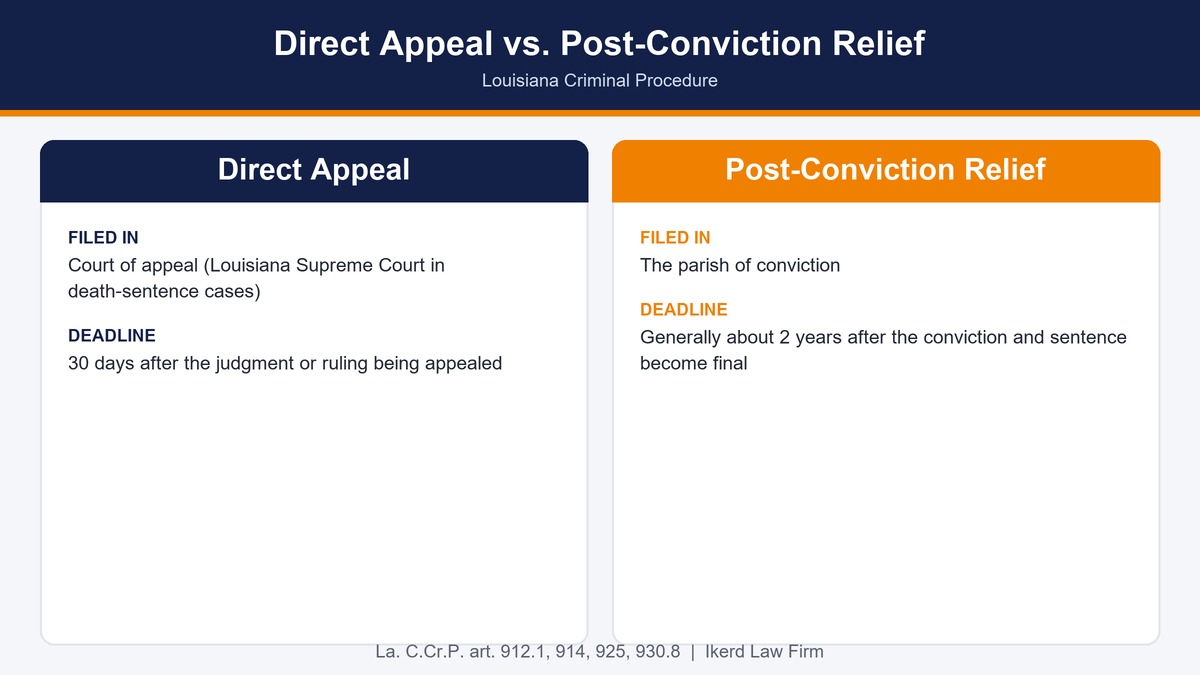
The 30-day appeal deadline starts when the judgment or ruling being appealed is rendered or, if a motion to reconsider the sentence was filed, when that motion is ruled on. The two-year post-conviction deadline starts later, when the conviction and sentence become final.
La. C.Cr.P. art. 930.8 measures the two-year period from the date the conviction and sentence became final under Article 914 or Article 922. La. C.Cr.P. art. 922 sets when a judgment on appeal becomes final. In a case that was appealed, the two-year period begins only after the appeal process ends, which can be well after the sentencing date.
No. Under La. C.Cr.P. art. 924.1, a court will not consider a post-conviction application while the person can still appeal the conviction and sentence, or while an appeal is pending. The direct appeal comes first. A post-conviction application, if one is filed, comes only after the conviction and sentence are final.
If the motion for appeal is not made within the 30 days set by Article 914, the direct appeal was not taken on time.
A request to restore that lost appeal is called an out-of-time appeal, and Louisiana law handles it as a post-conviction matter. La. C.Cr.P. art. 930.8 applies its two-year time limit to every application for post-conviction relief, “including applications which seek an out-of-time appeal.”
A request for an out-of-time appeal is made through a post-conviction application, and our firm does not handle post-conviction applications.
The choices made during a direct appeal can limit what a court will consider afterward. Under La. C.Cr.P. art. 930.4, a claim that was fully litigated in an appeal shall not be considered in a later post-conviction application.
The current version of that article, amended in 2026, also requires a court to deny relief in other situations. Two of them involve a claim the petitioner knew about and failed to raise in the proceedings leading to conviction and a claim the petitioner raised in the trial court and then failed to pursue on appeal.
For that reason, the issues selected for a direct appeal deserve careful attention while the appeal is still open.
You may be deciding whether to keep your trial lawyer for the appeal or bring in a separate appeals attorney. We also cover what to look for when choosing a criminal appeals attorney.

If a conviction was entered recently and the 30-day appeal period has not passed, or if a direct appeal is already underway, our office can speak with you about the appeal. You are not alone in this process, and you do not have to sort out every question before you call.
Chad Ikerd served nearly a decade as First Assistant Chief Defender in the 15th Judicial District. He also served as a regional supervisor for the Louisiana Appellate Project. He has handled more than 1,000 felony cases and more than 200 writs and appeals. Our South Louisiana criminal appeals lawyer page explains how the firm approaches appellate work.
Call the Ikerd Law Firm at (337) 366-8994 or contact the Ikerd Law Firm online. Please note that in criminal appeals, our firm handles direct appeals only. We do not take post-conviction relief cases.
A direct appeal asks a court of appeal to review the trial record for legal error, and the motion for appeal must be made within 30 days under La. C.Cr.P. art. 914. Post-conviction relief is a separate application filed in the parish of conviction after the conviction and sentence become final, generally within two years under La. C.Cr.P. art. 930.8.
The motion for appeal must be made no later than 30 days after the judgment or ruling being appealed, or 30 days from the ruling on a motion to reconsider sentence if one was filed, under La. C.Cr.P. art. 914.
Yes. Under La. C.Cr.P. art. 924.1, a court will not consider a post-conviction application while the person can still appeal or while an appeal is pending.
In Douglas v. California, 372 U.S. 353 (1963), the United States Supreme Court held that an indigent defendant’s first appeal as of right may not be decided without the help of counsel. Post-conviction relief works differently. Under La. C.Cr.P. art. 930.7, the court may appoint counsel in some situations and must appoint counsel when it orders an evidentiary hearing on the merits.
No. The Ikerd Law Firm handles direct criminal appeals. We do not handle post-conviction relief applications.
 Ikerd Law Firm
 Sep 23, 2026