

Call for Consultation (337) 366-8994
Call for Consultation (337) 366-8994





This page provides general information only and does not constitute legal advice. Reading this page does not create an attorney-client relationship. Laws vary by jurisdiction and change frequently. Always consult a licensed attorney for advice specific to your situation.
If an 18-wheeler hit you because its brakes or equipment failed, more than one party may be liable.
A truck accident brake failure lawyer looks at two paths: negligence against the trucking company if the truck was not maintained properly and product liability against the manufacturer if the part was defective when it was built.
Both paths exist under Louisiana and Texas law. The Ikerd Law Firm handles 18-wheeler cases in both states. Call (337) 366-8994, or talk to a Louisiana & Texas truck accident lawyer about what happened.
When a loaded 18-wheeler cannot stop, the easy explanation is that the driver made a mistake. That may be the explanation you are given after the crash.
But brakes and equipment wear out, and federal law requires carriers to monitor their condition regularly, not just occasionally.
If the brakes or another system on that truck were in poor condition, what happened to you is more than just one bad moment behind the wheel. It points to how the truck was maintained, who was responsible for maintaining it, and whether the parts themselves were sound.
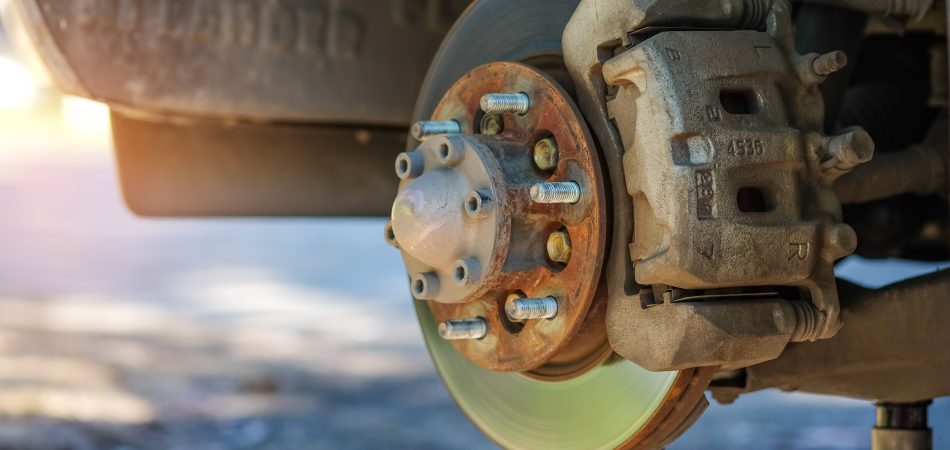
Most commercial trucks use air brakes, which are powerful but demand regular upkeep. The most common failure is simple wear: linings and pads thin out over time, and once they are past their wear limit, they cannot generate the friction needed to stop a fully loaded rig, often alongside heat damage from a downgrade.
Out-of-adjustment brakes are another frequent problem. Air brakes rely on a mechanical stroke to press the shoes against the drum, and if that stroke drifts out of range, the brake does not do the work it should, and several out-of-adjustment brake systems at once sharply cut stopping ability. Air system failures add a third category, since leaks, moisture, a failed compressor, or a stuck valve can rob the system of pressure and turn a controlled stop into a dangerous one.
A worn tire can blow out, steering components can wear or break, and the coupling devices holding a tractor and trailer together, including the fifth wheel and kingpin, can separate the two units.
Each of those is a different defect, and each one opens the same two paths a brake failure does.
 Three federal rules set the standards a truck’s brakes have to meet, and two more set what the carrier has to do about them. 49 CFR § 393.47 sets minimum thickness requirements for brake linings and pads, with limits that depend on the type of brake system and the axle position.
Because 18-wheelers use air brakes, they are generally held to a 1/4 inch minimum for most axles.
Requirements for steering axles are also specific, typically requiring at least 3/16 or 1/4 inch, depending on the brake design. The 1/16-inch minimum sometimes cited in general information applies only to hydraulic or electric brakes, which are rarely used on large commercial trucks.
49 CFR § 393.48 states the simplest requirement: every brake must operate at all times, with only narrow exceptions.
49 CFR § 393.52 sets measurable braking performance standards, covering braking force, deceleration rate, and stopping distance. Any test under the rule is run on a hard surface that is substantially level, dry, smooth, and free of loose material. That standard matters when post-crash testing shows the truck should not have been on the road.
49 CFR § 396.3 requires every trucking company to systematically inspect, repair, and maintain its vehicles, which is the backbone of most maintenance-negligence claims because it establishes upkeep as an ongoing obligation, not an occasional courtesy.
49 CFR § 396.17(c) goes further. A carrier may not use a commercial vehicle unless every component listed in the rule’s appendix has passed an inspection at least once during the preceding 12 months, with documentation of that inspection on the vehicle.
It is a distinct annual check, and a carrier cannot satisfy it by pointing to routine repairs. See our page on federal trucking regulations and negligence in Louisiana for more.
There is one more standard, and you will see it in the truck’s inspection history. The North American Standard Out-of-Service Criteria, published by the Commercial Vehicle Safety Alliance, is the pass-fail standard roadside inspectors apply, and it identifies the critical violations that take a driver, a vehicle, or its cargo out of service until the problem is resolved.
Defective brakes are among the conditions it covers. The criteria are reissued annually, effective April 1 of each year, and the 2026 edition is the current one. An out-of-service order sitting in a truck’s inspection history is a documented finding made at the time, not an opinion formed after a crash.
 When a truck’s brakes or equipment fail, responsibility can run in two directions, and a strong case often considers both.
One path targets the people who were supposed to maintain the truck; the other targets the company that built the part. Louisiana and Texas each recognize both paths but reach them through different statutes.
Ordinary negligence claims can arise if a carrier fails to discover a worn brake during a reasonable inspection. In Louisiana, these claims run through La. Civ. Code art. 2315, which provides that every act of a person who causes damage to another obliges the one whose fault caused it to repair it.
Louisiana courts apply that article through a duty-risk analysis, so a violation of a federal maintenance rule still has to be connected to the harm before it works in a case.
Texas governs commercial trucking cases through the Texas Trucking Liability Act, added by House Bill 19 in 2021 and amended by House Bill 2190 in 2023.
Under Tex. Civ. Prac. & Rem. Code § 72.052, a defendant can have the trial split in two. It does not happen on its own, and it is not up to the judge either.
The defendant must move for it, generally within 120 days of filing its original answer, and on a timely motion, the court must order it. The first phase then decides liability and compensatory damages, and a second phase, if it is reached at all, decides exemplary damages.
Under Tex. Civ. Prac. & Rem. Code § 72.053, evidence of a safety regulation violation, such as the brake-operability rule at 49 CFR § 393.48 or the maintenance duty at 49 CFR § 396.3, is admissible in that first phase only if two things are true: the evidence tends to show that the violation was a proximate cause of the injury, and the regulation is specific and governs, or is part of a duty of care that applies to, the defendant, its employee, or its equipment.
Texas also adopts these standards as its own. Tex. Transp. Code § 644.051 directs the director of the Department of Public Safety to adopt rules on the safe operation of commercial motor vehicles, requires those rules to be consistent with the federal regulations, and allows the director to adopt all or part of the federal safety regulations by reference. What differs between the two states is how a violation can be used in court.
The second path applies when the part itself was defective when it left the factory, no matter how carefully the trucking company maintained it.
In Louisiana, the state’s Products Liability Act is the only route. Under La. R.S. 9:2800.52, the Act sets out the exclusive theories of liability against a manufacturer, and a claimant cannot recover from a manufacturer on any theory that the Act does not contain.
Under La. R.S. 9:2800.54, a manufacturer is liable for damage proximately caused by a characteristic of its product that makes the product unreasonably dangerous, provided that the damage arose from a reasonably anticipated use of the product. A product is unreasonably dangerous in one of four ways, and only those four: construction or composition, design, an inadequate warning, or a failure to conform to an express warranty. Louisiana’s four categories are written into the statute itself.
This applies to brakes, tires, steering, and coupling components alike.
Texas evaluates defective-part claims under Tex. Civ. Prac. & Rem. Code Chapter 82. Texas uses three categories: manufacturing, design, and marketing or warning defects.
Those come from Texas case law rather than from an enumeration in Chapter 82. Louisiana’s fourth category, breach of express warranty, is governed by ordinary warranty law in Texas rather than the products liability statute.
A more critical distinction exists in Tex. Civ. Prac. & Rem. Code § 82.008, which lacks a Louisiana equivalent. That section gives a manufacturer a rebuttable presumption that it is not liable for a design, formulation, or labeling defect if the product complied with mandatory federal safety standards or regulations that applied when it left the manufacturer’s control.
That presumption can be rebutted. Under the statute, a claimant can overcome it by showing the federal standards were inadequate to protect the public from unreasonable risks of injury or damage or that the manufacturer withheld or misrepresented information material to the federal government’s determination of the standard. It reaches only design, formulation, and labeling claims. A manufacturing defect falls outside it.
More than one party may share responsibility for your crash, and the trucking company is not necessarily the only one who can be held accountable.
A truck that could not stop might reflect a maintenance failure, a defective part, or both, so a real investigation looks at the carrier’s maintenance records and the parts themselves.
The state where the crash happened matters too, since a maintenance violation and a defective part are proven through different statutes in Louisiana and Texas.
Evidence in these cases disappears quickly. Trucks get repaired, and the failed component can be replaced before anyone has examined it.
Acting early matters, and a guide on what to do after a truck accident in Louisiana walks you through the first steps.
Two other problems can sit alongside a brake failure. An overweight load lengthens stopping distance and pushes worn brakes past their limit, as explained on our page about overloaded and improperly secured cargo.
Additionally, a fatigued driver may miss a developing brake problem during inspection, which is an overlap covered on our page about hours of service violations in Louisiana trucking cases.
If a truck’s brakes or equipment failed and you were hurt, you may have more than one path to recovery. You do not have to work out which one before you call. The Ikerd Law Firm handles 18-wheeler cases across Louisiana and Texas and can investigate both sides of your crash. Call (337) 366-8994 to talk about what happened.
The most common causes are worn linings or pads, brakes drifting out of adjustment, and air system problems such as leaks, moisture, or a failed compressor, any of which can leave a loaded truck without the stopping power it needs.
It depends on why they failed. If poor maintenance caused it, the trucking company or driver may be liable for negligence. If the part was defective when it was made, the manufacturer may be liable under product liability law. Occasionally both share responsibility.
Yes. Under La. R.S. 9:2800.54, you may hold a manufacturer responsible where a characteristic of its product made it unreasonably dangerous and your damage arose from a reasonably anticipated use. That covers brake and coupling components.
Yes. Texas works from three defect categories rather than Louisiana’s four and adds a hurdle Louisiana lacks. Under Tex. Civ. Prac. & Rem. Code § 82.008, a manufacturer gets a rebuttable presumption against liability for a design, formulation, or labeling defect if the part met the applicable mandatory federal safety standard. It can be overcome, but it has to be.
Under Tex. Civ. Prac. & Rem. Code § 72.053, evidence that a carrier violated a specific federal safety regulation, such as the brake-operability rule at 49 CFR § 393.48 or the maintenance duty at 49 CFR § 396.3, is admissible in the first phase of a bifurcated trial, so long as the violation was a proximate cause of the crash and the regulation is specific to the duty at issue.
An air brake works through a mechanical stroke that presses the shoes against the drum. When that stroke moves outside its proper range, the brake does far less work than it should, and several out-of-adjustment brakes at once can sharply reduce stopping ability.
Federal law requires trucking companies to inspect, repair, and maintain vehicles on an ongoing basis and bars a carrier from using a commercial vehicle unless it has passed a full periodic inspection at least once during the preceding 12 months.
Yes. Federal maintenance standards apply to interstate trucks in every state they travel through, and our firm handles these cases in both Louisiana and Texas.
 Ikerd Law Firm