

Call for Consultation (337) 366-8994
Call for Consultation (337) 366-8994


DISCLAIMER
This article is for informational and demonstration purposes only. Sentencing calculations vary based on the Louisiana Department of Correction’s internal policies, and these policies are subject to change. Always consult a licensed attorney to evaluate your specific case or situation. Nothing in this article constitutes legal advice.
If someone is sentenced to five years in prison in Louisiana, the question most people ask is: “How much of that time will they actually serve?”
Previously, the answer varied based on an individual’s behavior, the nature of the offense, and their eligibility for parole or early release credits. But Louisiana’s sentencing laws have changed as of August 1, 2024.
With these new reforms, actual time served is now far more rigid. The once flexible system that allowed early release through good-time credits and parole has been replaced by a hard floor: inmates must now serve at least 85% of their sentence in most cases, and parole is no longer an option for most adult offenders.
This guide explains how Louisiana’s sentencing system works in 2025, compares pre- and post-reform laws, breaks down different offender scenarios, and helps you estimate how much time someone might serve on a 5-year sentence depending on their case.
Before the reforms, Louisiana used a tiered system that awarded sentence reductions through “good time” credits and offered parole eligibility for most inmates.
Because cases can take a long time, there will still be several years before all pre-August 1, 2024 cases are fully resolved. Therefore, understanding those laws is still relevant to today’s cases.
Under Louisiana’s revised criminal justice laws, crimes committed on or after August 1, 2024, fall under the new structure:
Even earned credits may be revoked due to:
Because rules differ by both offense type and when the crime occurred, here is how outcomes may look in typical situations for a 5-year sentence:
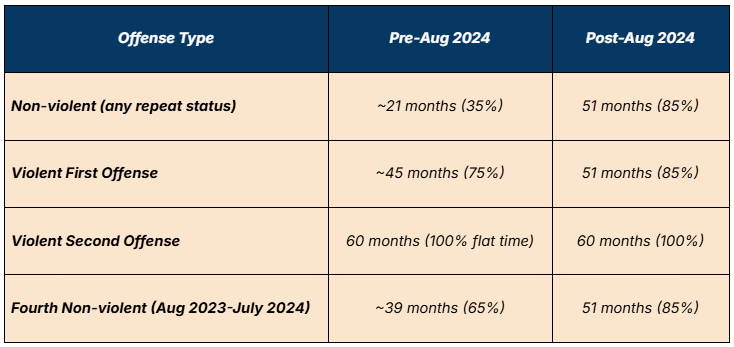
Note: Pre-2024 percentages are approximate ranges based on various factors, such as good time credits, parole eligibility, and program participation.
The changes have implications beyond individual cases:
Projected Costs
Criminal justice experts predict that Louisiana’s corrections budget and prison population will increase, potentially doubling in size over the next ten years. These are billions of dollars in additional incarceration costs for taxpayers.
Corrections officials expect to see an increase in the inmate population because inmates will be staying for longer sentences than before.
Louisiana’s local facilities, where most people serve their sentences, offer few rehabilitative programs. Longer sentences mean more time spent without access to opportunities for change.
The elimination of meaningful early release opportunities changes the value of different plea options.
A plea agreement that might have seemed reasonable under the old system now carries much harsher real-world consequences.
Knowing that conviction means serving 85% of any sentence affects the risk-benefit analysis of going to trial versus accepting a plea agreement.
With limited opportunities for early release, the initial sentence becomes much more important.
Fighting for the smallest sentence becomes even more important because defendants will serve almost their whole sentence.
This might involve:
With the stakes now much higher, investing in a strong defense to avoid conviction entirely becomes more valuable.
This includes:
Knowing which offenses are excluded from good time (sex offenses and habitual offender sentences) helps in case evaluation and strategy development.
Louisiana’s 2024 changes represent a shift away from criminal justice reform and toward a more punitive approach. These laws will affect nearly everyone sentenced in the state after August 1, 2024, and will set prison and sentencing reform back decades.
The changes reflect a political decision to prioritize punishment over rehabilitation, which is the prerogative of the policy-creating representatives of the people—the Legislature and Executive brances.
For defendants and their families, the decision means that criminal charges carry higher stakes than ever before.
Given the severity of these changes, anyone facing potential criminal charges in Louisiana should:
An experienced attorney’s early intervention can sometimes prevent the filing of charges or lead to more favorable plea negotiations.
Do not rely on outdated information about Louisiana sentencing. The 2024 changes mean that a 5-year sentence now means serving over 4 years in prison, not the much shorter periods that were possible under the previous system.
Explore every possible defense and negotiation strategy. This includes challenging evidence, seeking reduced charges, and presenting strong mitigation evidence.
Louisiana’s criminal justice system has become more complex and punitive. Working with an attorney who understands both the old and new systems is crucial for effectively handling these changes.
While the sponsors of these bills stated that the intention was to create more certainty in sentencing (not necessarily to increase the actual time served), the reality is different. People will spend more time behind bars.
Your case decisions, from initial charging choices to plea negotiations and trial strategy, now carry consequences that will affect years of your life.
If you are facing criminal charges in Louisiana, do not face them alone. Contact a qualified Louisiana criminal defense attorney such as the Ikerd Law Firm immediately to understand how these changes might affect your specific situation and what can be done to protect your future.
Call (337) 366-8994.
References


